Strategi Pengembangan Produksi Pertanian Sektor Hortikultura di Kecamatan Mallusetasi, Kabupaten Barru
Development Strategy Agricultural Production in the Horticulture Sector in Mallusetasi District, Barru Regency
Abstract
Mallusetasi District, Barru Regency is trying to improve the agricultural sector in horticultural commodities. Horticultural crops are the mainstay, although it is not yet known and determined which leading horticultural sector will be developed by related parties, in this case the local government. This study aims to analyze the base sector in Mallusetasi District, Barru Regency. The method used in this study is location quotient (LQ) analysis to determine the base sector, dynamic location quotient (DLQ) analysis to determine development potential this year and the next few years and SWOT analysis to determine strategies in developing base sector commodities in Mallusetasi District. The results showed that the horticultural commodity which became the basis sector with superior classification was watermelon. In the development effort through SWOT analysis it was found that the watermelons cultivated in Mallusetasi District were in a position to grow and develop with an aggressive strategy which meant that farmers had to be able to use their power to optimize the use of opportunities in the form of assistance from the government, market access and superior seeds for horticultural commodities.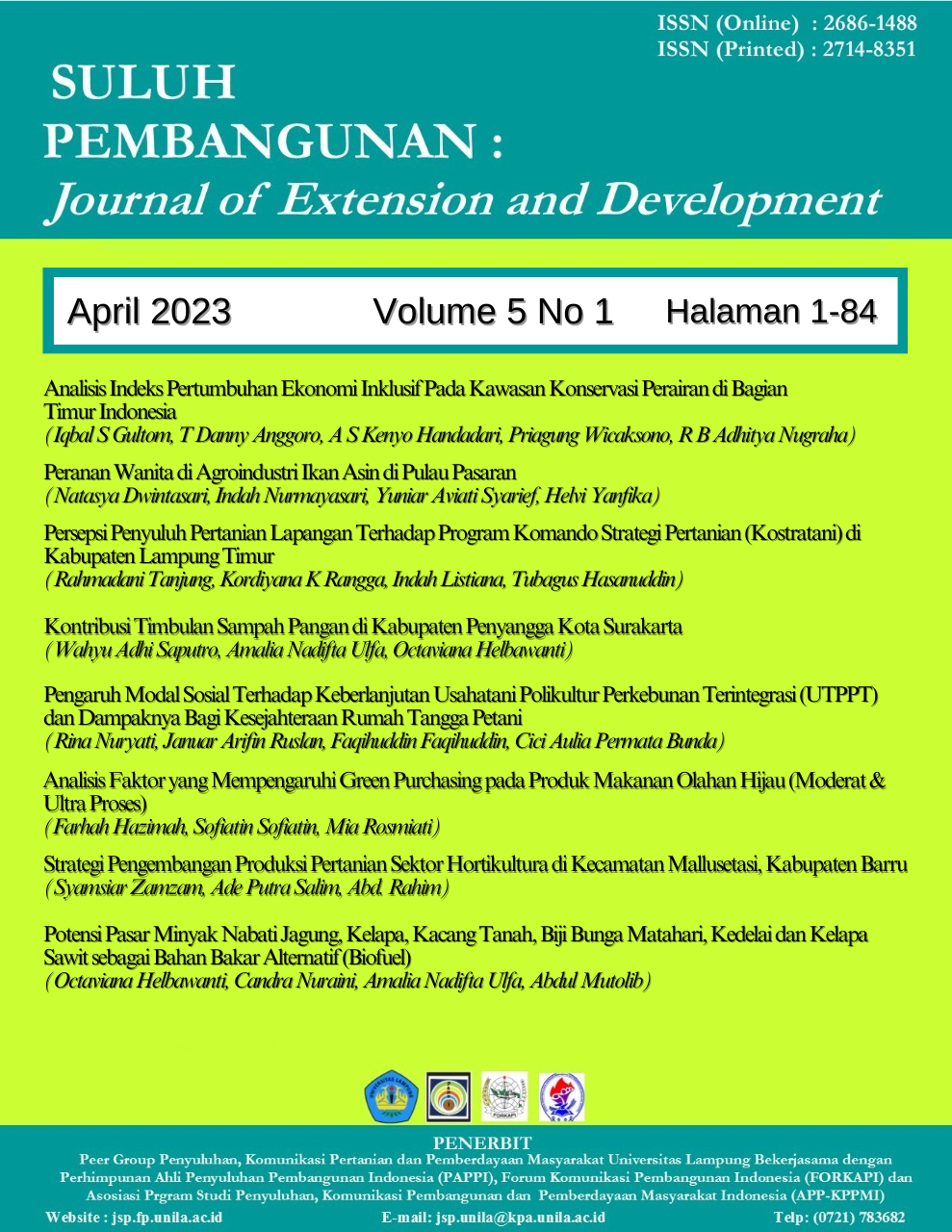
Published
2023-04-29
How to Cite
Zamzam, S., Salim, A. P., & Rahim, A. (2023). Strategi Pengembangan Produksi Pertanian Sektor Hortikultura di Kecamatan Mallusetasi, Kabupaten Barru. Suluh Pembangunan : Journal of Extension and Development, 5(01), 65-74. https://doi.org/10.23960/jsp.Vol5.No1.2023.181
Section
Articles
Authors who publish with this journal agree to the following terms:
- Authors retain copyright and grant the journal right of first publication with the work simultaneously licensed under a Creative Commons Attribution License that allows others to share the work with an acknowledgement of the work's authorship and initial publication in this journal.
- Authors are able to enter into separate, additional contractual arrangements for the non-exclusive distribution of the journal's published version of the work (e.g., post it to an institutional repository or publish it in a book), with an acknowledgement of its initial publication in this journal.
- Authors are permitted and encouraged to post their work online (e.g., in institutional repositories or on their website) prior to and during the submission process, as it can lead to productive exchanges, as well as earlier and greater citation of published work (See The Effect of Open Access).